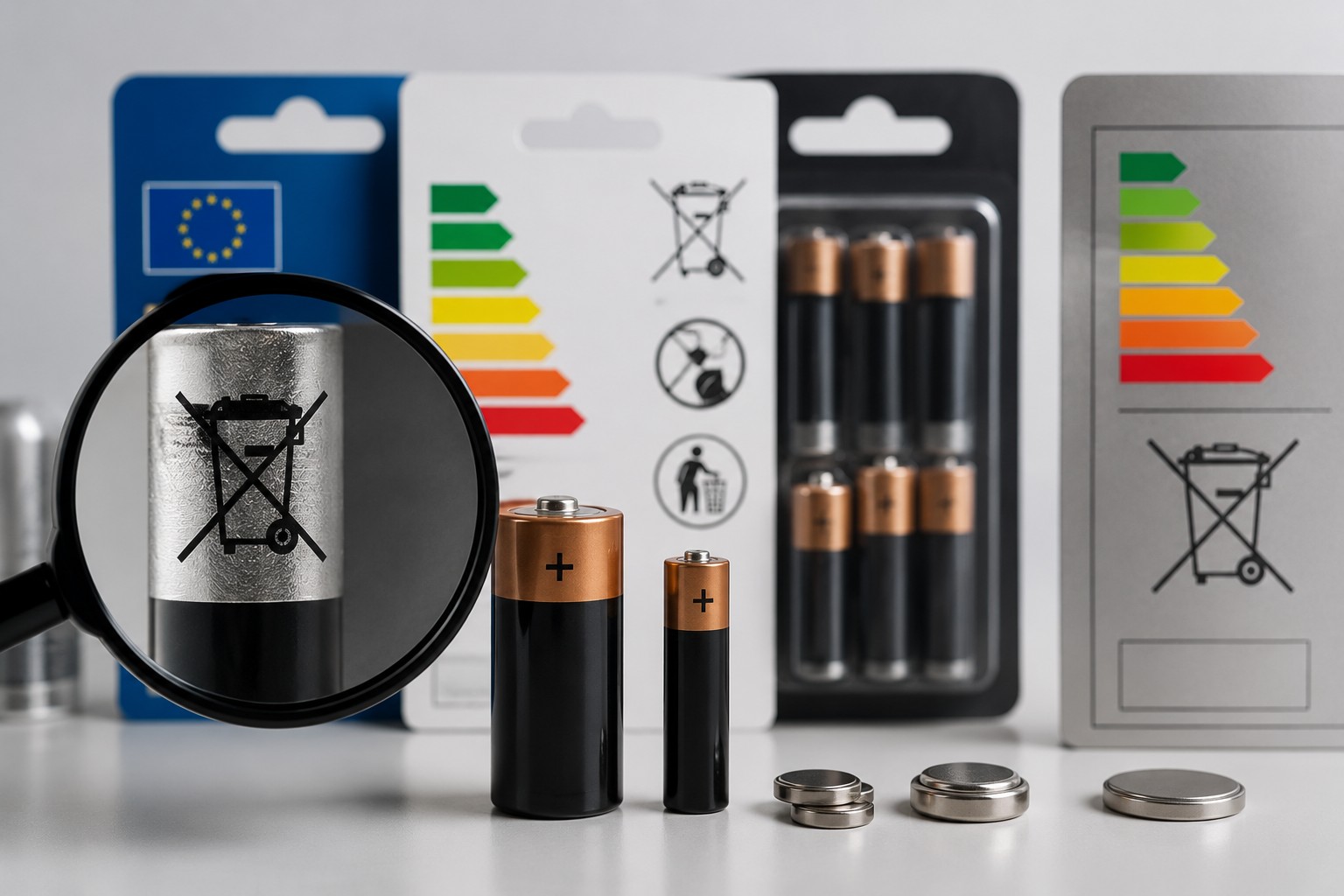
“Non-rechargeable” means the battery is not designed to be electrically recharged, and for EU-bound portable primary batteries that wording now sits inside a much broader labeling framework. The harder part for importers and private-label buyers is not understanding the phrase itself; it is deciding which label elements apply, when they become mandatory, and how printed information should match the approved battery specification. Regulation (EU) 2023/1542 ties the non-rechargeable indication to minimum-average-duration information, general battery data, separate-collection marking, and later QR-code requirements. A sound artwork review therefore has to start with legal timing and product data, not with packaging layout alone.
The Regulation defines a non-rechargeable battery by intended design: it is a battery that is not designed to be electrically recharged. For a technical buyer, that definition is more useful than a simple “do not put this in a charger” interpretation because it links the label directly to the product category being placed on the market.
A primary battery may be physically connected to charging equipment, but that does not make recharge part of its intended use. The label is therefore not describing quality, price level, or expected runtime; it is identifying how the battery is designed to be used.
That distinction matters during private-label approval. If the technical specification describes a primary battery, then the artwork, instructions, symbols, and product description should not suggest a rechargeable use case. A mismatch here is not merely a wording issue. It means the packaging no longer describes the approved product consistently.
For procurement teams, the useful check is whether the specification, artwork, and compliance file all classify the battery in the same way.
Article 13 does more than require a non-rechargeable indication. It also brings non-rechargeable portable batteries into a wider label structure that includes general battery information and a specific requirement for minimum average duration in defined applications.
Annex VI Part A lists the information that the general battery label is intended to contain. That includes manufacturer identification, battery category and product identification, place and date of manufacture, weight, capacity, chemistry, certain hazardous substances, usable extinguishing agent, and specified critical raw materials above the stated threshold.
Label Element | What a Buyer Should Verify |
Manufacturer identification | Matches the responsible economic operator |
Battery category / identification | Corresponds to the correct specification and artwork |
Place and date of manufacture | Supports traceability |
Weight and capacity | Matches the approved product data |
Chemistry | Correctly identifies the electrochemical system |
Hazardous-substance information | Reflects the applicable technical information |
Critical raw-material information | Included where Annex VI thresholds apply |
Minimum average duration | Supported by the required application/test basis |
This is why label approval should not sit entirely with a graphic designer. Much of the printed content originates from technical, quality, regulatory, or manufacturing records, and changes to those records can affect the artwork.
For non-rechargeable portable batteries, Article 13 requires information on minimum average duration when the battery is used in specified applications.
A duration figure without its testing context is of limited value. Purchasing teams need to know what application or discharge basis supports the printed result, particularly when several suppliers are being compared. If different test conditions sit behind two duration claims, the numbers should not be treated as directly equivalent.
The practical approval question is whether the label claim can be traced back to a defined test basis rather than whether the number looks competitive.
No. This is one of the easiest parts of Article 13 to misread. The Regulation states that the relevant general label and non-rechargeable portable-battery requirements apply from 18 August 2026 or 18 months after the entry into force of the implementing act referred to in Article 13(10), whichever is later.
A compliance calendar that shows only “18 August 2026” is incomplete. Before approving production artwork, the buyer needs to check the final implementing act and calculate the later date required by Article 13.
That is especially important in private-label programs where packaging may be printed for months of production. Applying a requirement based on a simplified headline can create unnecessary reprinting, while missing the later legal trigger can create the opposite problem.
A useful internal record should therefore note both the underlying Regulation and the implementing measure used to determine the applicable date.
The Commission has published draft implementing material with more detailed proposed label-design rules, including format and presentation requirements. Those drafts can help procurement and packaging teams prepare systems and artwork space, but draft material should not be treated as the final legal basis for a production release.
Final artwork approval should be tied to the adopted measure that is actually in force at the time the requirement becomes applicable.
A non-rechargeable indication sits alongside other EU battery markings that follow different timelines. Combining those reviews can save rework, but each requirement still needs to be treated separately because the symbols communicate different information.
From 18 August 2025, batteries must carry the separate-collection symbol shown in Annex VI Part B. Article 13 also specifies minimum sizing rules, including separate provisions for cylindrical cells and cases where the battery itself is too small to carry the required minimum-size symbol.
The crossed-out wheeled-bin symbol does not replace a non-rechargeable indication. One tells the user how the battery should enter waste collection; the other identifies that the battery was not designed to be recharged.
Where relevant, Article 13 also requires Cd or Pb markings when the specified cadmium or lead concentration thresholds are exceeded.
From 18 February 2027, all batteries must carry a QR code under Article 13. For batteries outside the battery-passport categories, that QR code is intended to provide access to the applicable Article 13 information, the declaration of conformity, and specified waste-management information.
That creates a practical planning issue for packaging approved during 2026. A pack may be suitable for one production window but still need a controlled artwork revision when the QR-code obligation applies.
For buyers managing long print runs, it is therefore worth separating “current release” and “next regulatory revision” in the packaging plan rather than assuming one artwork will remain unchanged indefinitely.
The most dependable review starts with the battery specification and works outward. Artwork comes last. If product identification, chemistry, performance information, manufacturing data, or legal timing is uncertain, graphic completion does not solve the underlying problem.
A controlled file should identify the battery model, chemistry, rechargeable status, manufacturing information, relevant performance basis, required symbols, artwork version, and compliance-review date. For repeat orders, that record becomes the reference point for determining whether a packaging change is cosmetic or whether it affects technical compliance.
The value of this approach becomes clearer when several battery sizes or pack formats share similar branding. Without a controlled link between product and artwork, an old version can easily be reused for the wrong item.
Before printing is released, the team should be able to answer three questions without searching through scattered emails: which battery does this artwork belong to, which legal requirements were used when it was approved, and which technical records support the printed statements?
Jiaxing Minimoon Battery Co., Ltd. develops and manufactures mercury-free zinc-manganese batteries for international markets, including primary battery categories relevant to non-rechargeable labeling requirements. For EU-bound projects, buyers can use the company’s battery product categories, alkaline battery range, and carbon zinc battery range to identify the exact format covered by an artwork review. Keeping chemistry, technical data, manufacturing information, test basis, and packaging version tied to the same order record makes later compliance checks and repeat production easier to control.
For EU procurement, the phrase “non-rechargeable” is only one part of the labeling decision. Buyers also need to verify the applicable Article 13 date, the general information required by Annex VI, the basis for minimum-average-duration data, separate-collection marking, and the later QR-code requirement. The safest release process keeps each printed statement tied to an approved battery specification and a documented legal basis. If either the product data or the applicable rule changes, the artwork should be reviewed again before the next production run.
Not exactly. Under the EU Batteries Regulation, the classification is based on product design: the battery is not designed to be electrically recharged. That makes the wording part of the product definition rather than only a consumer-use warning.
Article 13 provides for minimum-average-duration information in specified applications for non-rechargeable portable batteries. Buyers should also check the test or application basis supporting that value before using it for artwork approval or supplier comparison.
No. The Regulation uses 18 August 2026 or 18 months after the relevant implementing act enters into force, whichever is later. The final implementing measure therefore needs to be checked before fixing the applicable date.
No. They communicate different requirements. The separate-collection symbol concerns disposal and collection, while the non-rechargeable indication identifies that the battery was not designed for electrical recharging.
Article 13 sets 18 February 2027 as the date from which all batteries must carry the required QR code. The information accessed through it depends on the battery category and the regulatory provisions that apply to that product.


 Carbon Zinc Battery