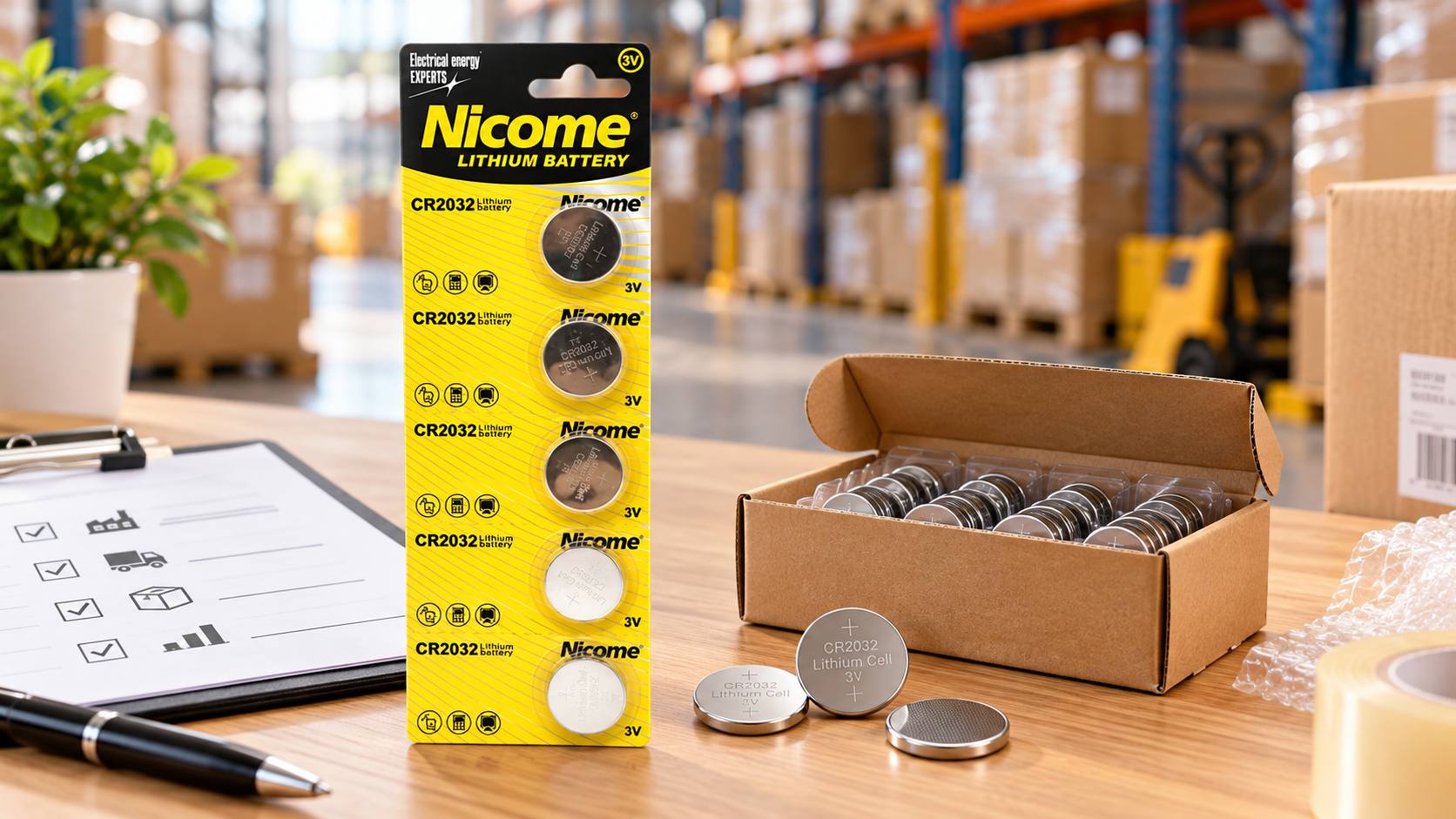
A CR2032 order can appear ready and still spend days waiting for decisions that have nothing to do with cell production. This often happens with repeat business: the buyer knows the battery, the supplier has quoted before, and both sides expect the next shipment to follow the same routine. Then the quantity changes, an old artwork file is questioned, or the required shipment date arrives before the packaging has been released. For purchasing teams, the useful way to manage lead time is to identify what must be fixed before factory scheduling begins. Product approval, packaging, forecast quantities, and the purchase order should move on a visible timeline rather than being treated as one general “order confirmed” date.
A missed shipment date does not always mean production itself was late. A considerable amount of waiting can happen before the order reaches the production schedule.
The first step is to find out whether the order is genuinely ready to run or merely commercially agreed.
Consider a repeat private-label order. The buyer sends the PO on Monday, but the packaging team is still checking an older artwork version. On Wednesday, the sales team requests a different quantity. The carton mark is confirmed on Friday.
From a purchasing perspective, the order started on Monday. From an operational perspective, several important decisions remained unfinished for most of the week.
The same issue can appear around:
Order Detail | Possible Effect on Timing |
Final quantity | Changes material and capacity planning |
Packaging format | Determines packing preparation |
Artwork version | Can delay printing or packing |
Carton information | Affects shipment preparation |
Product reference | Must remain consistent with the approved order |
This distinction matters when reviewing a late shipment. If most of the delay occurred before the supplier had complete information, increasing factory pressure on the next order will not solve the underlying problem.
There is no advantage in keeping routine decisions open until the last possible moment. Once samples have been accepted and the commercial format is settled, buyers gain more from maintaining a stable reference than from repeatedly reopening details.
Product and packaging decisions do not have to be completed on the same day, but they should be tracked separately.
Repeat orders frequently rely on phrases such as “same as previous order.” That works until different versions exist.
A controlled purchasing record can identify the approved CR2032 reference, previous order number, pack configuration, artwork version, and carton requirement. When the next quotation arrives, purchasing can compare it against the actual approved order instead of searching through old email threads.
For the CR2032 format itself, buyers can use the supplier’s CR2032 product page as the product-level reference during early discussions.
Private-label packaging can have a different timeline from the battery.
The cell may already be accepted while a retailer is still approving wording or graphics. Treating both activities as one approval hides the real status of the project.
A simple order file can record:
l product approved;
l artwork released;
l packaging details frozen;
l PO confirmed;
l requested shipment window.
When a date moves, the team immediately knows which part changed.
Urgent orders often begin several weeks earlier, when declining stock is visible but no purchasing decision is made. Once inventory reaches a critical level, the buyer asks the supplier to compress a schedule that was never planned as urgent in the first place.
Repeat demand gives buyers an advantage: previous consumption can be used to decide earlier.
For a distributor, the forecast may simply show expected demand for the next few purchasing cycles. An OEM buyer may connect CR2032 consumption with the production plan for the finished device.
The number does not need to become the final PO quantity immediately.
What matters is giving the supplier advance visibility that another order is likely to arrive and roughly how large it may be. When the final PO is released, the discussion starts from an existing planning assumption rather than from zero.
A forecast sent once and never updated can create false confidence.
Suppose the buyer originally expected 100 units of demand in a planning period and then wins a new customer that materially changes the requirement. The earlier schedule discussion may no longer apply.
The reverse is also true. If a promotion is cancelled or customer demand weakens, telling the supplier early can prevent unnecessary preparation.
Forecasting works best as a conversation, not as a spreadsheet that disappears after it is sent.
Lead time is easier to control when both sides agree on what starts the clock. Surprisingly, this point is often left unstated.
A buyer may count from the day the PO is issued. The supplier may count from the day final artwork arrives. Both may quote the same production period and still expect different shipment dates.
Before releasing the order, purchasing can confirm whether scheduling depends on any of the following:
l final sample approval;
l artwork release;
l packaging confirmation;
l payment milestone;
l final quantity;
l buyer-supplied marks or documents.
This is particularly relevant when comparing a standard wholesale order with a private-label program.
A standard configuration with previously approved packing may require fewer steps. Custom packaging introduces additional decisions, and those decisions need space in the schedule.
Problems also arise when purchasing, sales, and logistics are working toward different dates.
An internal sales target, requested factory completion date, and actual shipment date are not interchangeable. Recording one agreed shipment target, together with the assumptions behind it, reduces confusion when the order is reviewed later.
Keeping a large safety stock is one way to avoid shortages, but it is expensive and does not correct a weak ordering process.
For many repeat CR2032 programs, moving the decision date forward is more useful than adding another layer of inventory.
A buyer can look at normal consumption, stock on hand, goods already in transit, supplier timing, and internal approval time. The reorder point should leave enough space for a normal order rather than assuming every future shipment can be expedited.
This becomes particularly valuable when purchasing serves several customers from the same inventory. A few unexpected orders can quickly consume what looked like comfortable stock.
Actual shipment history is often more useful than a generic lead-time figure.
For each order, record the dates that matter:
l PO issued;
l final approval completed;
l production started;
l production completed;
l goods shipped.
If something moved, note why.
After several orders, the pattern becomes visible. Perhaps artwork regularly consumes four extra days. Perhaps the buyer changes quantity after the PO. Perhaps factory timing is stable and the real variation occurs in shipment booking.
That information gives the next buyer a realistic schedule instead of an ideal one.
Jiaxing Minimoon Battery Co., Ltd. supplies batteries for international wholesale and OEM requirements. Buyers discussing CR2032 projects can review the company’s CR2032 product information together with its lithium battery range before confirming a commercial order. For repeat or private-label purchasing, bringing the approved battery reference, packaging version, quantity, artwork status, and requested shipment window into the same discussion gives both teams a clearer starting point. It also makes later schedule reviews more useful because changes can be traced to a specific order decision rather than being described simply as a production delay.
Lead-time problems in CR2032 wholesale sourcing often begin before production, when specifications, quantities, packaging, or approvals remain unsettled. Buyers can remove much of that uncertainty by separating product and artwork milestones, discussing repeat demand before stock becomes urgent, and confirming exactly when the quoted schedule begins. After delivery, recording what actually happened provides a better reference for the next purchase. Over several orders, those records can reveal where time is repeatedly being lost and whether the next solution belongs in purchasing, packaging, production planning, or logistics.
Yes. By the PO stage, the buyer should already understand which approvals the supplier requires before scheduling. Otherwise, the PO date and the actual start of the order may be several days apart.
Yes. Cell approval and packaging approval are separate matters. Private-label artwork, barcode details, carton marks, or other printed information can remain unfinished after the battery itself has already been accepted.
It can be quite simple. Expected volume, current inventory, goods already in transit, and the likely date of the next order are often enough to give the supplier useful visibility before the final PO arrives.
It can reduce short-term risk, but it also ties up inventory. Earlier reorder decisions and more reliable approval timing may provide additional buffer without requiring the buyer to carry substantially more stock.
Keep the PO date, final approval date, production milestones, shipment date, and any reason the schedule changed. Comparing several completed orders gives buyers a practical lead-time history for future planning.


 Carbon Zinc Battery