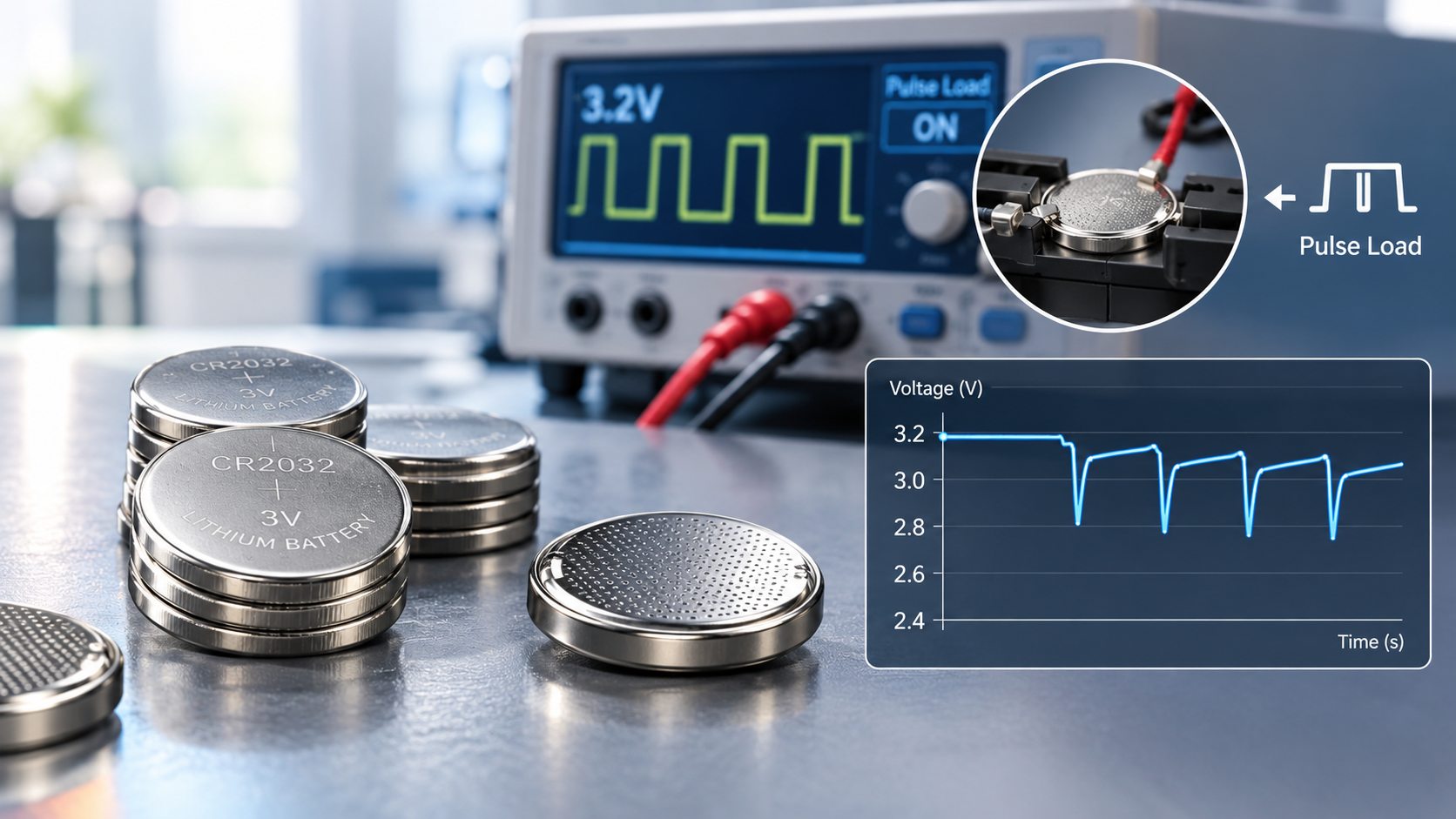
Lithium coin cells can have a normal open-circuit voltage and still plunge during a short, high-current pulse. That may cause resets, poor wireless signals, or low-battery indications even when a brief, rapid voltmeter check seems OK. For buyers, quality engineers, and product designers, the real question isn‘t about how close to nominal a cell appears when not doing work, but by how much it drops during the pulse, how fast the voltage recovers afterward, and whether multiple cells maintain similar characteristics. A practical test thus must simulate the load in the actual application.
A pulse exposes electrical behavior that an open-circuit measurement cannot show. Once current rises suddenly, internal resistance and electrochemical polarization create a temporary voltage loss.
There can be two cells with very similar open circuit voltage but which behave totally differently when you pulse the battery with the same time pulse. The cell with the higher internal resistance will generally have the greater terminal voltage dip.
Resistance of the cell depends on cell construction, temperature, state of discharge, the history of storage and on the test conditions. Do not compare a value obtained in one test condition with a value obtained in another.
For buyers, consistency is as important as the absolute value. A batch with several cells showing noticeably higher resistance may perform differently when used in pulse-driven equipment.
The voltage may drop very rapidly at the start of a pulse and may continue to change while the load is applied. When the load is removed, it will usually return to the resting voltage.
That recovery yields diagnostic information. If it’s just the voltage being recorded before the test, the tester isn’t recording what’s going on during operation.
Open-circuit voltage alone reveals only the most blatant defects. It exerts next to no load on the cell. A battery will pass incoming inspection and still go bad when someone pulls a short burst of current out of it.
A wireless transceiver, remote, tracker, electronic lock, or sensor module will often work at a relatively low current, followed by a burst of significantly higher current during a transmission or other brief event.
Average current may therefore appear to be low despite the device being held above the minimum operating voltage by the pulse. That is the reason why some failures seem only to appear while transmitting.
There isn’t necessarily a cell that’s causing the voltage dip. The components including the battery holder, springs, plated contacts, debris, or not enough pressure on the circuit can contribute resistance.
Test voltage at both the device input and the battery terminals for the same pulse. If the voltage drop at the device input is much higher, the contact path should also be checked.
The most effective test matches the real demands of the intended application. While a standard resistance load can be used for initial screening, a realistic pulse profile offers more convincing evidence for production approval.
Record pulse current, pulse duration, interval between pulses, minimum device operating voltage, and test temperature.
Test Item | What to Record |
Open-circuit voltage | Baseline before loading |
Pulse current | Actual or simulated peak demand |
Pulse duration | Length of the current burst |
Minimum loaded voltage | Lowest voltage reached |
Recovery voltage | Voltage after the pulse ends |
Temperature | Test environment |
For a device that resets during transmission, minimum loaded voltage is usually more informative than the resting voltage measured before the test.
The result can vary if you change the fixture, temperature, pulse width, point of measurement or test sequence. Samples should be compared on one defined setup.
Much should not be given when just one or two chosen samples are performing well. A more meaningful question is whether the regular variation within the accepted batch will still leave sufficient voltage margin for the device.
A fresh cell may work normally at room temperature yet provide less voltage margin later. Temperature, storage history, and state of discharge can all influence loaded performance.
Lower temperature is associate with slower electrochemical reactions, and an increase in internal resistance. This means that a device functioning normally at room temperature may experience a bigger voltage drop when cold.
If the completed equipment is designed for outdoor use, freezer rooms or through temperature swings, room-temperature testing may not simulate the real usage.
As a primary lithium coin cell is used, its loaded behavior changes. Storage conditions may also influence pulse performance over time.
For applications with little voltage margin, qualification may need to include more than brand-new cells. Testing at a representative state of discharge or after an agreed storage condition can reveal problems that fresh samples do not show.
Replacing the cell is a useful first check, but diagnosis still needs to separate the battery, electrical contacts, and device load.
A practical troubleshooting sequence is:
l reproduce the failure;
l capture pulse current and pulse duration;
l measure minimum voltage at the battery terminals;
l measure minimum voltage at the device input;
l inspect the holder and contact pressure;
l repeat the test using known-good reference cells.
The more obvious the deeper drop in one sample while the reference cells hold out, the more a battery is likely to be a suspect. If all the cells go out at about the same point, then the load on the device, the voltage, or the contact system might be of more interest.
Acceptance limit should not be placed right at the device shut down voltage. Temperature, aging, contact resistance, and normal batch variation take away some margin.
Purchasing and engineering teams should determine the pulse method and minimum acceptable loaded voltage before mass production begins, rather than quantifying this limit only after a field complaint.
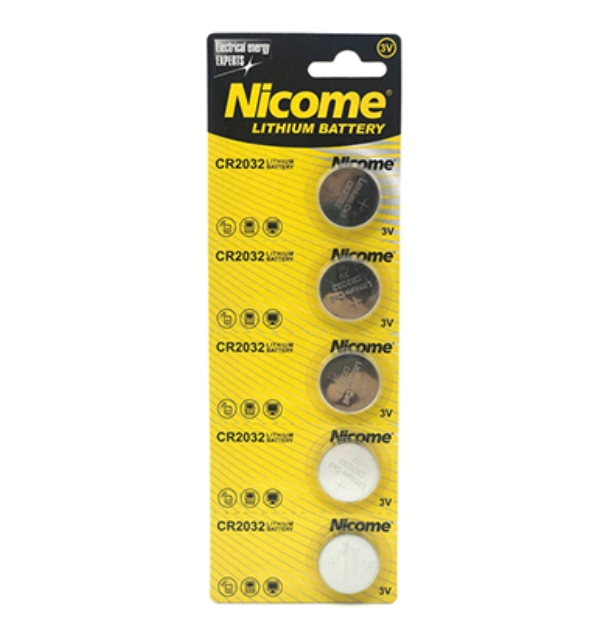
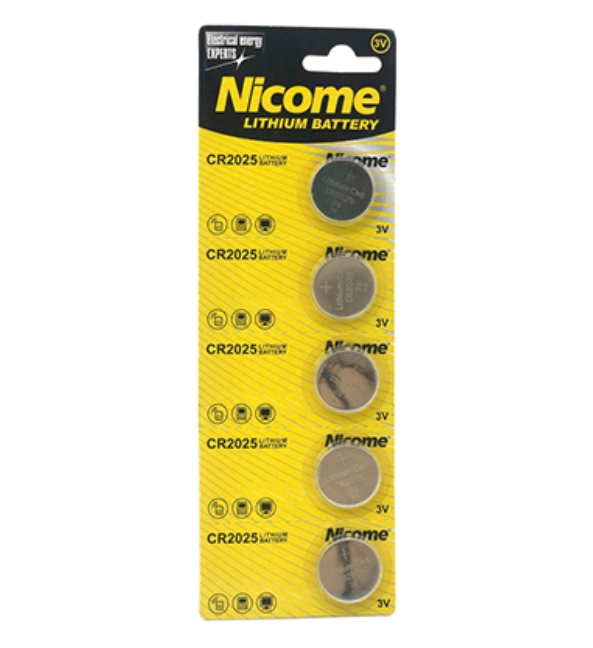
Jiaxing Minimoon Battery Co., Ltd. supplies batteries for international wholesale and OEM requirements. Buyers working with coin-cell applications can review the company's Lithium Battery range together with its CR2032 product page and CR2025 product page when confirming the required format before testing. For the projects of pulse load, it will be easier for sample comparison and later production check out to follow the same test specification as prescribed the reference of approved cells, pulse profile, temperature condition, fixture and minimum device voltage.
The voltage drop under pulse loads can’t be discerned from open-circuit voltage. Internal resistance, polarization, low temperature, the state of discharge and contact path resistance all affect the minimum voltage perceived by the device. Buyers checking for resets or weak transmissions should simulate the real pulse, verify voltage at the cell and the device input, then compare multiple samples of the same part, all under the same conditions. Device acceptance limit must include the actual minimum operating voltage and include sufficient headroom.
Yes. Open circuit voltage can appear okay, but the load voltage drops too far under a short burst of current. Pulse testing is more relevant when the failure occurs during transmission or during some other high current scenario.
No. Polarization, low temperature, state of discharge, contact resistance, and device wiring can also contribute. Measurements at both the cell and device input help separate these possible causes.
Record open-circuit voltage, pulse current, pulse duration, minimum loaded voltage, recovery voltage, temperature, and the device‘s minimum operating voltage. Use the same test conditions when comparing samples.
Not when the final product will experience other temperatures. Low temperature can increase voltage sag, so qualification conditions should reflect the environment in which the device will actually operate.
An appropriate number of samples cannot be decided by a universal number. It should be based on the application risk, production quantities, and the agreed acceptance plan, with a number of cells tested in the same way.


 Carbon Zinc Battery