
A leaking AAA battery found in a device that has stopped working raises two different questions: why did the cell leak, and was the device still drawing current after useful operation ended? Cell reversal is one possible link between them. With several cells in series, an exhausted one may end up being driven below zero volts by the others. Whether that happened in the returned device is another matter. A photograph of the leak won't answer it, and choosing a replacement supplier before checking the circuit can leave the original cause untouched.
Picture a series set with one partly used cell among fresher ones. There's no separate current path for that cell: it has to carry the series current with a smaller reserve. It reaches exhaustion first. If current keeps flowing, supplied by its neighbors, its terminal voltage can cross zero and become negative. That is the reversal at issue here. Correct installation doesn't prevent it. The marked positive and negative ends can face exactly as the compartment requires while the cells run down unevenly. An old cell among new ones makes the problem easier to understand, but don't assume a mixed set without checking its history.
A blank display can be misleading. There may still be a powered circuit behind it. Reading across the pack terminals won't settle the question either, since the remaining cells contribute voltage that can hide the exhausted cell's condition. A reversal investigation needs readings for each cell, taken while the device is in the relevant operating state.
When comparing a carbon-zinc battery range, include what the intended device does after its useful runtime. The right size can fit the holder and still need further application testing.
Look at the can as well as the voltage. In a cylindrical zinc-carbon cell the zinc anode contains the active materials, and that zinc is consumed during discharge. The container therefore changes as the battery delivers energy. Continued deep discharge can also increase internal gas generation and leakage risk. A weak cell being driven into reversal is consequently a concern, rather than a harmless extension of its service life.
There are other routes to a leak, including physical damage to the can or seal. How old was the set, and where had it been stored? Heat exposure is another part of the history to obtain. Residue found after the event gives no reliable answer to those questions. The electrical history has to supply the missing connection.

Don't start by switching the return on. Isolate the power first, then photograph the batteries in place so the record shows which cell occupied which position. Date codes and a note of the last complete replacement belong with those photographs. After the set has been removed, reconstructing its original arrangement may be impossible. Keep leaking cells out of any further powered test; use the handling instructions supplied for the batteries and the disposal arrangements applicable locally.
The table shows why apparently similar return notes can require different follow-up questions.
Finding | What it supports | What is still needed |
One cell leaked in a series set | A localized failure requiring investigation | Cell history, circuit drain, and physical condition |
Mixed old and new cells | A credible source of unequal remaining capacity | Did current continue after the weaker cell ran out? |
Very low voltage after removal | Depletion or another cell problem | An operating record; a low reading doesn't establish past reversal |
A minus-sign cell reading in a controlled test | Possible measured reversal | First rule out swapped probes, then check the test record |
For the engineering work, agree a laboratory procedure using separate, undamaged samples. The purpose is to examine the device's discharge behavior without reusing a compromised return. Have the laboratory record each cell as well as the complete set, with current and elapsed time, through the approach to the device's operating limit. Agree the probe orientation against the marked terminals before starting. A minus sign caused by reversed meter leads would send the investigation in entirely the wrong direction.
There is also a timing problem: voltage can recover when the load comes off. A bench reading after removal answers a different question from a measurement made in the running device. If that earlier measurement wasn't captured, leave the reversal diagnosis open. Do not turn an incomplete measurement into a supplier fault finding.
Start with the device's behavior after useful operation ends. Engineers should check shutdown and residual drain under the intended load and temperature conditions, including foreseeable differences between cells. A pack cutoff selected only from an average voltage per cell may not protect the weakest member. The cutoff needs application evidence; a universal AAA setting would ignore those differences.
Make complete-set replacement explicit in the instructions, using the battery type specified for the device. Adding fresh cells around an old one leaves unequal reserves in the same circuit. Also tell users to take exhausted batteries out promptly and to follow the device's removal instructions before long storage. Recharging isn't an option for these primary zinc-carbon cells.
Order replacement kits in quantities that let the user change a whole set at once; the available AAA pack formats can help with that choice. That convenience has limits: putting two or four cells in one package doesn't demonstrate matched capacity, let alone protection against reversal. Ask separately for the proposed cell specification and application test conditions.
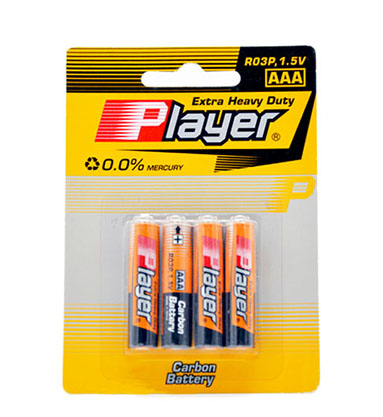
The zinc-manganese range from Jiaxing Minimoon Battery Co., Ltd. includes AAA supply options, with OEM production also described on the company website. Buyers looking for this size and chemistry can start with the PLAYER R03P 2PCS/BLISTER listing, then send the device and battery requirements for discussion. A useful inquiry explains the circuit as well as the purchase: the series-cell count, current during use and standby, and shutdown behavior as the set runs down. Add the return record if there is one. These details give the supplier something concrete to assess when confirming available product data and sample testing; the catalog listing alone doesn't establish protection against deep discharge.
For a leakage complaint after prolonged use, follow the current beyond the point where the device appeared to stop. If it could keep flowing through an exhausted member of a series set, reversal belongs in the investigation. The missing step is often a record of what happened electrically before the return reached the buyer. Keep that limitation visible. Changing the battery order may be appropriate, but the decision needs to follow the evidence collected from the cells and the device.
The mechanism discussed here requires other cells in a series circuit to drive the depleted cell. A leaking single-cell device still needs investigation, but this series-cell explanation should not be applied to it.
Replacing the affected cell alone leaves the other cells' condition uncertain. Remove the complete set and address any compartment damage before reuse according to the device instructions. Persistent drain or an unsuitable shutdown strategy also needs correction.
Only an agreed test can support a defined performance claim. Write the intended conditions into the request, including the discharge load and endpoint, temperature, waiting period after discharge, and the definition of a failed sample. Otherwise a test result may describe something quite different from the proposed use. A general catalog description cannot establish that guarantee.


 Carbon Zinc Battery